
Memory’s Toll
Recently, biopic directors have become more keen to use them for sketching stories about either the human nature or an individual entangled within systemic machinations. Pablo Larrain, with his Jackie (2016), Spencer (2021) and El Conde (2023), has been second to none in this regard, but both Marie Kreutzer (Corsage) and Sofia Coppola (Priscilla) have also shied away from the traditional and safe approach to memoirs. However, with the release of his first feature film, Michael Dahan goes a step further by probably constructing the most unique, even in terms of its form, portrait of a character who, in spite of being torn between two irreciprocal truths, is scrambling to find answers to questions pertaining to identity and the toll memory has (the national one included).
Before the first screening of Yes Repeat No as part of the Free Spirit Competition at the Warsaw Film Festival took place, on the 7th of October 2023, Hamas launched an unprecedented retaliatory attack on Israel, therefore continuing one of the biggest modern world conflicts and making Dahan’s movie all the more meaningful. After all, the Israeli-American filmmaker tells a story of Juliano Mer-Khamis who considered himself to be “a born and bred Israelite and Palestinian.” Born in Nazareth, Israel and murdered in Jenin, Palestine, he was the son to a Jewish activist fighting for the Palestinians’ and Arabs’ right to identify as Christians. A peaceful activist, a director, the founder of the Freedom Theatre, a movie and stage actor, and a man who, in 2011, was shot down by two unknown assailants due to the suspicion of being a double agent. He starred, mainly in the capacity of a supporting actor, in eighteen movie productions, including George Roy Hill’s The Little Drummer Girl (1984), which served Dahan as a narrative tool in building the storyline.
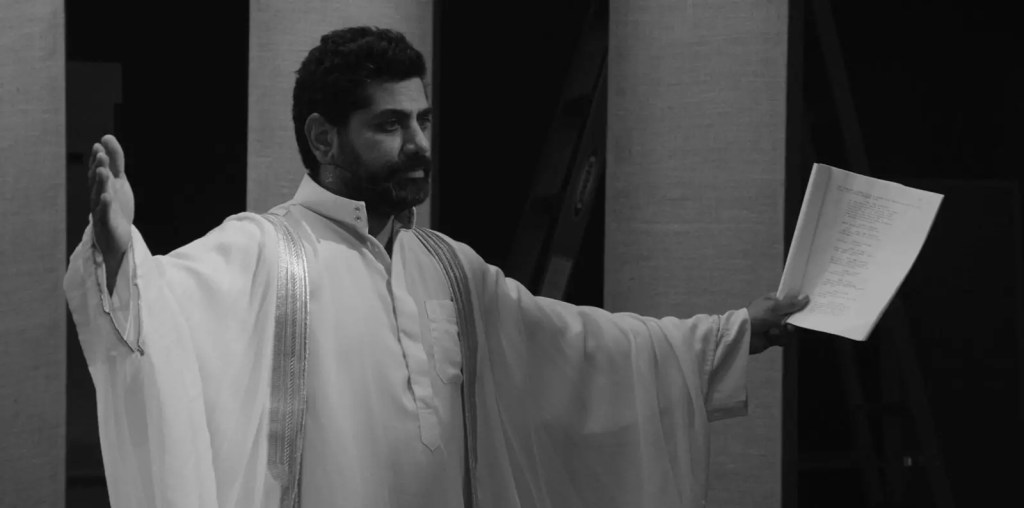
Yes Repeat No breaks through the traditional perception of a biography in nearly all aspects. Above all, it replaces hard facts for an attempt to create not merely a concept of the main protagonist, but his archetype. The story is contained inside the space of a movie studio in which the audition for the role of Juliano Mer-Khamis is underway. The beautiful but completely uninviting Yael the Director (Salome Azizi), on whose desk there’s a mug bearing a bittersweet sign which reads “The tears of your ancestors”, is just about to begin the spectacle of guiding and provoking the three actors who have decided to show up. And because each of them has been sure of having gotten the part, the very presence of other jacks of the same trade is flabbergasting. Yet, the explanations they’re given don’t alleviate that state. Ultimately, each of them has been tasked with the reenactment of a different period from the murdered activist’s life. Thus, we meet Israeli Juliano (Karim Saleh) who’s constantly flirting with the Director but knows nothing about the main protagonist, Arab Juliano (Mousa Hussein Kraish) who keeps saying that “we all know who Juliano was” and asking not to refer to the Palestinians and the Lebanese as Arabs, and Public Juliano (Adam Meir) who’s a media persona in the flesh of a somewhat jaded, playboy-like man being no stranger to ideological confrontations and dropping bombs wherever he needs them to fall. For the next 98 minutes, the four of them will come to blows with not only one another, but also with their own systems of values founded upon deeply internationalized upbringing frameworks.
Every now and then, Yael the Director is forced to underline the purpose of the meeting, which is to find a common ground, a mysterious connection point, between all three characters, as it’ll result in choosing the lead actor. However, with each passing minute, the plot, as it’d in any worthy thriller, thickens to the point where each party loses sight of the script and steps out of their roles. What Dahan sets out to check is whether, as stipulated by the Stanford prison experiment, the human behavior is really intertwined with a social role, and to that end, he dresses each of his actors in different-colored suits (white, black and gray) and begins to address them by the name of a given color, but after a short while, he instructs them to switch the attire so as to make them put themselves in the proverbial someone else’s shoes. What offers tremendous help in the moulding of the main protagonist’s image is the monochrome movie picture. Nonetheless, the American filmmaker, even at the level of form, will keep toying with meanings, as well as with space, by mixing dimensions and taking the audience backstage, being the working area depicted with the use of color, where handheld shots are king and meticulous black and white images are done away with, and where he himself, the bearer of the script, while dishing out advice to Saleh, Kraish and Meir, spins the wheel of inception, which blurs the lines between the studied and improvised, the reality and fiction, or what’s true and false.
The rhythm and pace of the movie are modulated by the metronome which sets the background for the ever worsening moods of all the parties taking part in this peculiar meeting. Yes Repeat No, because of the heft it carries, which is evident especially in terms of the dialogue structure, warrants utter focus. How word-heavy the movie really is can be overwhelming and off-putting. This technique, however, has been used for a reason, and Dahan knows exactly when to take the foot of the gas and leave the audience alone in silence. It’s bemusing to see how thought through and perfected the work is down to a single detail and word, or with how strong a discipline Dahan controls the narrative planes, while still being able to extract satisfaction from juggling various styles. Touching upon one of the most tense relationships of the modern world, which in itself suggests standing in opposition to what’s holy (the movie was barred from Israeli and Arab cinema festivals, which is a testament to how vital it is), manifests one’s artistic courage. Still, what won’t be found here is harsh criticism similar to that of Nadav Lapid’s who in all his movies, from Policeman to Ahed’s Knee, pinpointed every transgression of Israel, no matter if it was military in nature or had to do with being in control of its own culture. Dahan’s aim isn’t to paint the world in black and white or to, in fact, create a political manifesto in spite of displaying his dismay of the actions taken by both sides of the conflict, with the inclusion of the US who’re present in other world disputes, as well.
Dahan, through the application of sublime methods, strives to sketch a universal story which is to unmask the nature of the conflict, its heroes and executioners, the ones who pull the strings and their accidental victims, as well as how easy it is to turn a person into an ideology. Even though the premise itself, i.e. war and death are both without meaning, isn’t novel, the distance that needs to be covered to reach the final scene, where the audience is left surrounded by an empty space reminiscent of a post-battle vista, a battle where there were no winners, constitutes an example of an excitingly fresh view on movie matter. The director provokes the audience the same way he did his actors by asking if they truly choose their roles and identities, or if they are, indeed, forced upon them or completely random. Whose name do we fight in? Is letting go off the past the only thing we need to remember to keep on living? Memory’s toll is hurtful, and despite that, none of the parties wants to deal with it.
All in all, Yes Repeat No is a multi-dimensional feast for the intellect, a tasty puzzle revolving around the matters of existence and identity, which, under different selection rules, should fight for (and win) a Grand Prix at the festival. The movie is just as much a song about freedom, escaping the grasp of obsolete systemic boundaries and having the courage to think critically, as it is a study of how relative the portrayal of not only historical figures, but also ourselves can be, as long as it doesn’t account for the changes in the angle at which the light is shed.
Original text in polish you will find on PEŁNA SALA: REVIEW.
Yes Repeat No
Michael Dahan / USA / 2023
cast: Salome Azizi, Karim Saleh, Mousa Hussein Kraish, Adam Meir

