Frailty, thy name is man
Ruben Östlund, the main mocker of contemporary cinema, has had the honor to join the eight directors who wield two Cannes Golden Palms award. In his latest masterpiece, he floods us with comedy, making fun of all – not sparing anyone, without exception, but – which is what he is best known for – mostly targeting men. We are intoxicated with brilliant humor, which mocks, above all, the hypocrisy of the elite, the loud, but empty declarations of the modern world, the capitalist system and the drug of power. Buckle up.
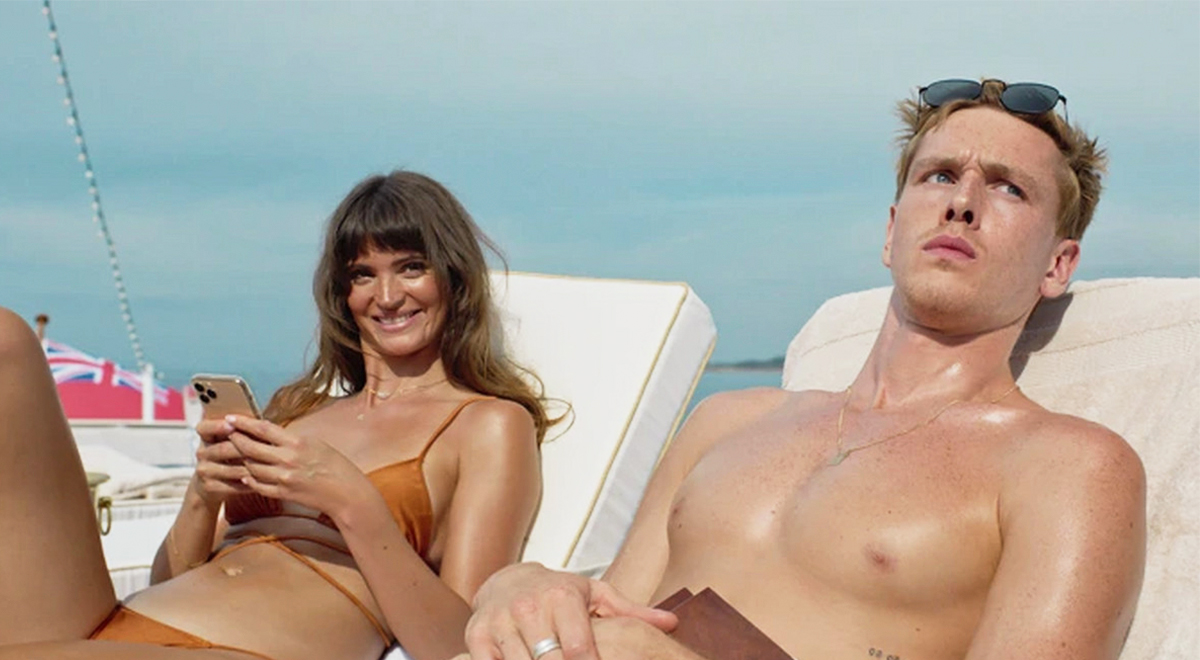
Triangle of sadness is divided into three parts, the first of which may seem detached from the whole. However, it is a kind of buckle, which at the end buckles the story together, providing quite an unexpected end considering the director’s achievements. The first segment is centered around a supermodel and influencer Yaya (Charlbi Dean) and her boyfriend Carl (Harris Dickinson), also a model with excellent physical attributes, but almost always sent home from job castings with a bill, without success. This time however he receives a bill for dinner in an exclusive restaurant, which will become the bane of his existence. Who should pay and why? The person who extended the invitation, in accordance with the principles of savoir-vivre, the one who earns more, or maybe “traditionally” – a man? The comic quarrel over money is, of course, only a pretext for contemplating contemporary male gender roles.
The second part takes place on an exclusive yacht on which our couple rest. The ship is commanded by the Captain (Woody Harrelson), a hybrid of a Marxist and an alcoholic, who despises his filthy rich guests, but not so their money. The structure of the boat reflects the tissue of social strata. On the upper deck, we have wealthy holidaymakers who demand immediate fulfillment of even the most bizarre cravings, such as the fact that all employees use an inflatable slide, reserved only for guests. Who are we to judge the rich, you may ask. Downstairs, the crew manager conducts motivational training, a corporate sign of our times, reminding her subordinates of the hefty tips that await them in exchange for their polite service to holidaymakers. Of course, the lowest deck belongs to manual workers whose skin color is far from white. The hierarchy does not surprise anyone, we all know it too well, we all participate in it. The complaint of a disgruntled visitor means to be or not to be here, even if it is caused by pure male jealousy and not by an actual act of wrongdoing. Östlund once again relates to white, heterosexual males with a financial and ancestral advantage over a potential rival, testing the limits of his ego and exposing complexes.

The captain, drowning his sorrows of the past and present in alcohol, ignoring the crew’s warnings about the impending storm, orders for caviar and champagne to be brought out instead of life jackets. Health and safety rules must give way to the delight of guests and potential earnings. The catastrophe which is in the air seems to be an inevitable piece of the puzzle in the script. Those who survive it will experience Östlund’s final scene – a desert island where the existing division of power will unexpectedly reshuffle, and the training of self-proclaimed leaders will be as fun as it is tragically tangible and universal. Will the new circumstances our characters have found themselves in be able to change their existing habits? Or maybe the standards of comfort once known to them: the taste of caviar, the ticking of a Rolex, the habit of being serviced, will stay with them forever and will make themselves felt in even the most reverse conditions? And finally, what about those whose dreams of a better world will finally become reality? Will they be able to give up without a fight what they have been waiting for, for years humiliated by bourgeois whims? Will they sacrifice moral purity for the crippling drug of power?
Östlund loves to portray hypocrisy, especially that of the elite. Already in the opening scene of the film, he lays into large fashion corporations, and rightly so. On the one hand, dividing customers into wealthy admirers of sophisticated Balenciaga and the poor souls wearing basic H&M T-shirts, on the other hand pumping equality slogans in the media, are the most grateful subject for mockery. There are more signs of the times here, than we would probably like. But isn’t that our desire? Being one of the gears of this machine? Or – what is worse – participating in it while trying to wipe out the sin of consumption from yourself?
It is also worth looking at “Triangle of sadness” through the prism of the image of the female body reproduced in film art for decades, which was mentioned, for example, by Nina Menkes in her documented lecture Brainwashed: Sex-Camera-Power. The Swedish artist places the body of a man as the center of aesthetic impressions, not a woman. He fetishizes and sexualizes it from the very first scenes, in order to offer in the third act what is considered a truly female profession, and which is changing more and more boldly thanks to such films as, for example, “Good Luck to You, Leo Grande” by Sophia Hyde. After all, it is the woman who takes, not is taken – the relationship of power is shifting also in this aspect.
Of course, you can hold a grudge against the Swedish director for many things. His diagnosis of the contemporary world is quite blatant, and the interpretations of symbols is extremely obvious. Fecal humor, based on the lowest instincts, also does not seem to be the peak of cinephile dreams and aspirations. Despite this, the auditorium, which bursts into fits of laughter, says something different. Östlund can dress entertainment in an intellectual cloak and give it a refined taste like no one else. At the same time, it still remains unsurpassed in terms of lightness in diagnosing contemporary ills. Attentive viewers will probably not experience a revelation here, but this doesn’t have to interfere with the delicious fun. However, it’s not the humorous load that makes this picture strong, but the fact that the artist, honored with numerous awards, finally gives the man causative power which was removed from him in both Force Majeure and in The Square. Is it a form of compensation after years of “kicking a man when he’s down”, or a new stage in the master’s work? We will probably learn this from his next work.
Original text in polish you will find on PEŁNA SALA: REVIEW.
Triangle of Sadness / W trójkącie
Ruben Östlund / Szwecja / 2022
cast: Harris Dickinson, Charlbi Dean, Woody Harrelson, Vicki Berlin
 AGNIESZKA PILACIŃSKA